

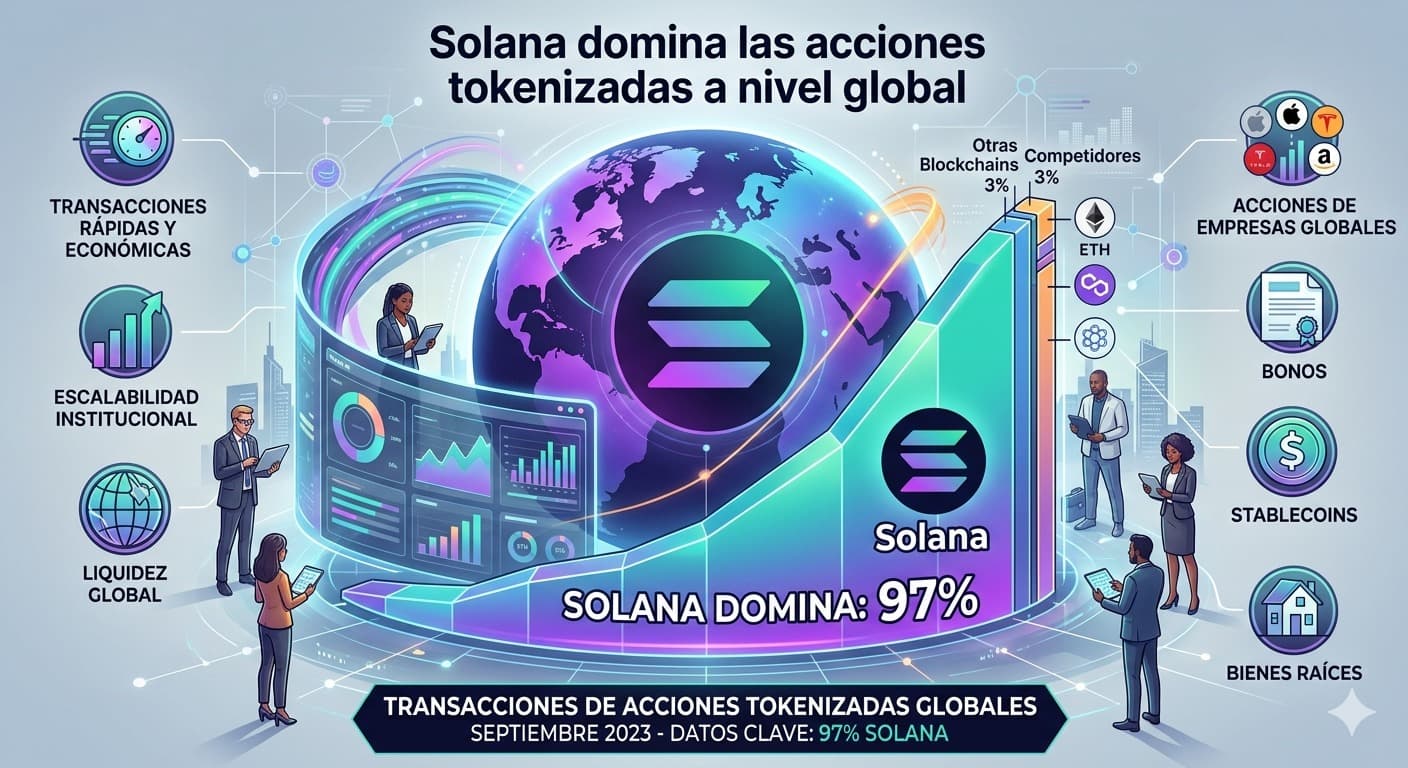
The Real-World Asset (RWA) landscape has reached a definitive tipping point. According to the latest on-chain data shared by the Solana Foundation, the high-throughput network has established a near-total monopoly in a critical sector of the decentralized financial ecosystem: a staggering 97% of all tokenized stock transactions globally were settled on its infrastructure over the past month.
This milestone is not an isolated event; it marks a historic, record-breaking month for real-world assets, stablecoins, sovereign bonds, and digital collectibles migrating to distributed ledger technology. With fractional fees and sub-second settlement times that outpace its primary competitors, the network has positioned itself as the default layer for financial institutions seeking to digitize legacy securities.
Bitcoin
The Rise of RWAs: Why Institutional Liquidity is Flocking to Solana
The tokenization of traditional financial instruments—such as equity in Apple, Tesla, or global index funds—demands a highly specialized technical infrastructure. While Ethereum has historically served as the cradle of decentralized finance (DeFi), its prohibitive gas fees and network congestion remain critical bottlenecks for high-frequency retail and institutional trading.
Solana’s ecosystem, built from the ground up with a hybrid consensus mechanism combining Proof of History (PoH) with Proof of Stake (PoS), allows the network to process thousands of transactions per second at an average cost of less than a penny. This extreme capital efficiency has triggered a massive migration of institutional order books, driving the volume of tokenized stock transactions away from legacy chains and onto Solana.
 European Central Bank Activates Pontes: Digital Euro Arrives in Banking Sector to Settle Tokenized Assets→
 Solana Captures 82% Market Share as Tokenized Equities Exceed $1.4B in July→
 Institutional Capital Moves Onchain: How Ripple Is Driving the Tokenized Asset Revolution→
Breaking Down a Record-Breaking Month
Data provided by network analytics highlights that this growth extends far beyond tokenized equities. On-chain U.S. Treasury bills (T-bills), institutional stablecoin issuance, and corporate liquidity pools have all posted unprecedented trading volumes. Capital is flowing rapidly into smart contracts capable of distributing automated dividend payouts and executing instant (T+0) settlements 24/7, completely bypassing traditional clearinghouses.

Industry Experts Weigh In on the Paradigm Shift
The consensus among digital asset strategists and traditional finance (TradFi) analysts indicates that we are witnessing a structural overhaul in how global wealth is transacted.
“The reality that the vast majority of tokenized stock transactions are concentrated on a single chain proves that global capital markets prioritize immediate finality and predictable overhead over extreme decentralization narratives,” notes Luis Cabrero, Market Analyst at CriptoMedios.
Furthermore, institutional adoption strategists from major digital asset funds agree that this trading volume validates the feasibility of managing real-world assets within parallel execution environments. Solana’s ability to process multiple transactions concurrently allows on-chain limit order books to operate with the same fluid liquidity as Wall Street trading desks, backed by the immutable transparency of blockchain technology.
The Global Market Impact: Democratization and Liquidity Pools
On a global scale, the institutionalization of RWAs bridges the gap between isolated liquidity pools. Historically, retail investors in emerging economies, as well as mid-sized institutional funds globally, have faced fragmented access to premier capital markets due to strict cross-border restrictions, high brokerage fees, and prohibitive minimum capital mandates.
Global Impact of RWA Tokenization
- Fractional Ownership: Borderless access with zero capital minimums
- 24/7/365 Instant Settlement: Elimination of T+2 clearing delays
- Global Liquidity Aggregation: Unifying TradFi assets on-chain
The surge in tokenized stock transactions on Solana-native platforms effectively democratizes this access. By facilitating fractional ownership—allowing users to purchase a minute fraction of a high-value U.S. corporate share without entry barriers—anyone with an internet connection and a self-custody wallet can diversify into robust global equities.
Inflation Hedging and Cross-Border Capital Flows
In regions navigating systemic fiat devaluation or capital controls, asset-backed tokens representing real equities and Treasury bonds serve as a highly liquid, censorship-resistant flight to quality. When paired with next-generation stablecoin rails, these tokenized securities provide multinational corporations and retail users alike with frictionless cross-border treasury management tools that far outperform traditional wire networks.
Navigating the Global Regulatory Maze
Despite clear technical and economic advantages, the long-term viability of tokenized stock transactions hinges on navigating a fragmented global regulatory framework. Watchdogs such as the U.S. Securities and Exchange Commission (SEC), ESMA in Europe, and MAS in Singapore are closely monitoring the public offering of digital assets tied to off-chain securities.
- Verifiable 1:1 Backing: The primary focus for global regulators remains verifying that every token minted in a public ecosystem is backed 1:1 by physical shares held in a fully regulated, compliant traditional custodian.
- Decentralized Identity (DID) & Compliance: Leading platforms deploying tokenized equities on Solana are increasingly embedding institutional-grade KYC (Know Your Customer) and AML (Anti-Money Laundering) compliance layers directly into smart contracts to filter participating addresses.
As comprehensive legislative frameworks like Europe’s MiCA (Markets in Crypto-Assets) and evolving tokenization guidelines in Asia mature, they will provide the necessary legal clarity for major investment banks to deploy trillions of dollars into public ledger architectures.
Conclusion: The Era of Programmatic Wealth
The concentration of 97% of all tokenized stock transactions on Solana confirms that efficiency, speed, and low transaction costs are the ultimate metrics for institutional adoption. Real-world assets are no longer a speculative proof-of-concept; they are rapidly becoming the bedrock of the next generation of global finance.
Ethereum
As user interfaces simplify and jurisdictional clarity solidifies, the traditional separation between Wall Street and Web3 will continue to dissolve, giving way to an always-on, borderless financial ecosystem.