

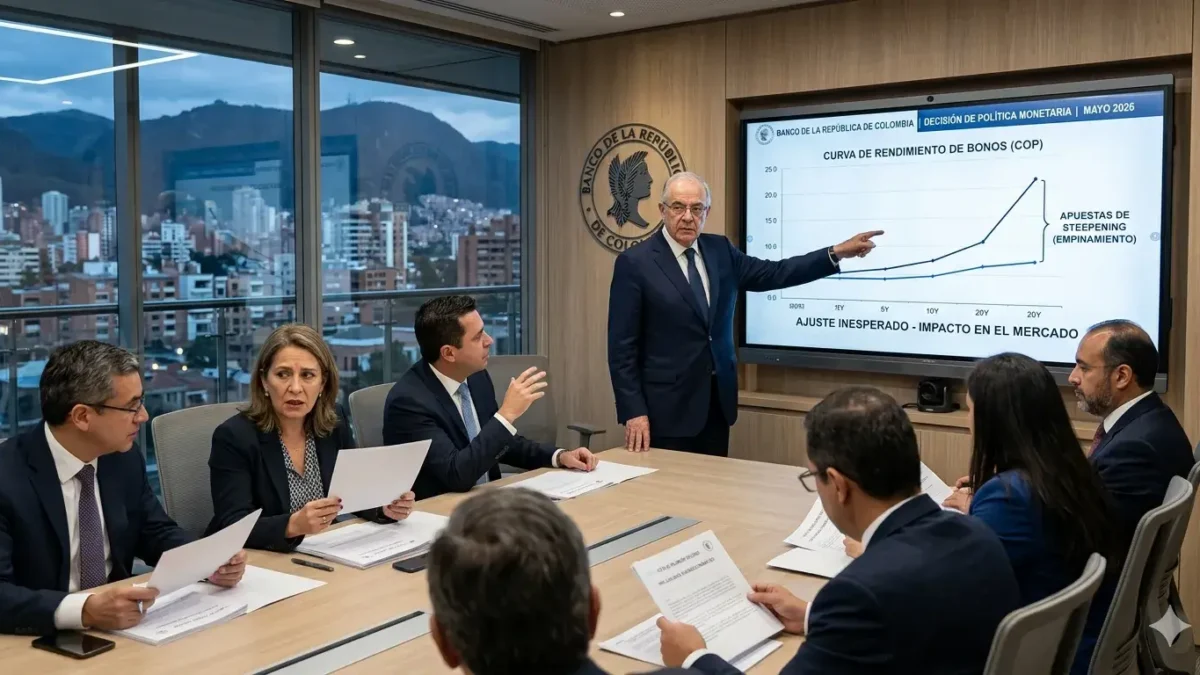
On May 1, 2026, the Bank of the Republic of Colombia It issued a monetary policy decision that has altered the projections of financial operators. The central entity surprised the market with an adjustment that was not fully discounted in prices, which has caused an immediate shift in investment strategies, particularly towards the ‘steepening’ bets on the yield curve. This volatility in traditional assets occurs at a time of reconfiguration of capital flows in Latin America.
Key details
- Unexpected decision: The central bank took a position that diverged from the consensus of Bloomberg analysts.
- Trader reaction: Increase in positions that anticipate a greater differential between short- and long-term interest rates.
- Exchange Impact: The Colombian peso has recorded volatility movements in direct response to the official statement.
- Regional trend: The measure positions Colombia in a different trajectory than other central banks in the region that maintain more conservative policies.
The return of theSteepingin Colombian bonds
The technical phenomenon known as Steeping of the yield curve occurs when the gap between short-term and long-term rates widens. The recent communication of Bank of the Republic of Colombia It suggests that the market now expects the bank to maintain or reduce short-term rates more aggressively, while long-term rates reflect concerns about future inflation or fiscal sustainability.
Why it matters
This story connects to Analysis, Latin America and helps readers follow the wider crypto and market conversation with more context.
Factors behind the market crash
according to the Bloomberg reports, the operators had not anticipated the magnitude of the change in the rhetoric of the Board of Directors. This gap between expectation and institutional reality has forced a closure of short positions and a re-evaluation of country risk.
Related: Analysis
Context of the financial sector in Colombia
Colombia is going through a period of economic adjustment characterized by a slowdown in domestic consumption and inflation that, although declining, shows persistence in the services sector. The Bank of the Republic of Colombia It has been under constant pressure to balance price control with the stimulus necessary to avoid a technical recession.
Related: Solana Captures 97% of Tokenized Stock Transactions in Landmark Month for RWAs
In the field of digital assets, the instability of the local currency or sudden changes in monetary policy often act as catalysts for the adoption of stablecoins linked to the dollar or bitcoin, as investors seek refuge from the devaluation of the peso.
Market implications (analysis)
From an analytical perspective, this movement reinforces the thesis that macroeconomic volatility in Colombia will continue in the short term. For the crypto and fintech sector:
- Rate arbitration: Divergence between local and global rates can encourage the use of DeFi protocols to optimize returns.
- Capital Protection: A steeper yield curve is often interpreted as a signal of long-term inflation uncertainty, which historically favors limited-supply assets.
RISKS AND LIMITATIONS
- Fiscal uncertainty: Central bank decisions do not operate in a vacuum; They depend on the budget execution of the national government.
- EXTERNAL FACTORS: A higher hardening of the U.S. Federal Reserve could nullify the effects of Colombian domestic policy, pushing even more upward long-term rates.
Stay informed, read the latest news about cryptocurrencies in real time!
Conclusion
The recent surprise of Bank of the Republic of Colombia Underlines the fragility of the market consensus in high-inflation environments. As traders adjust their portfolios for a steep curve scenario, financial ecosystem participants need to keep a close eye on weight stability and liquidity flow to alternative markets. Institutional transparency will be key to stabilizing expectations in the coming months.
Do you want to stay on top of how monetary policy affects your investments? Subscribe to our newsletter at criptomedios.com To receive exclusive analyzes and breaking news on the financial and crypto market.