

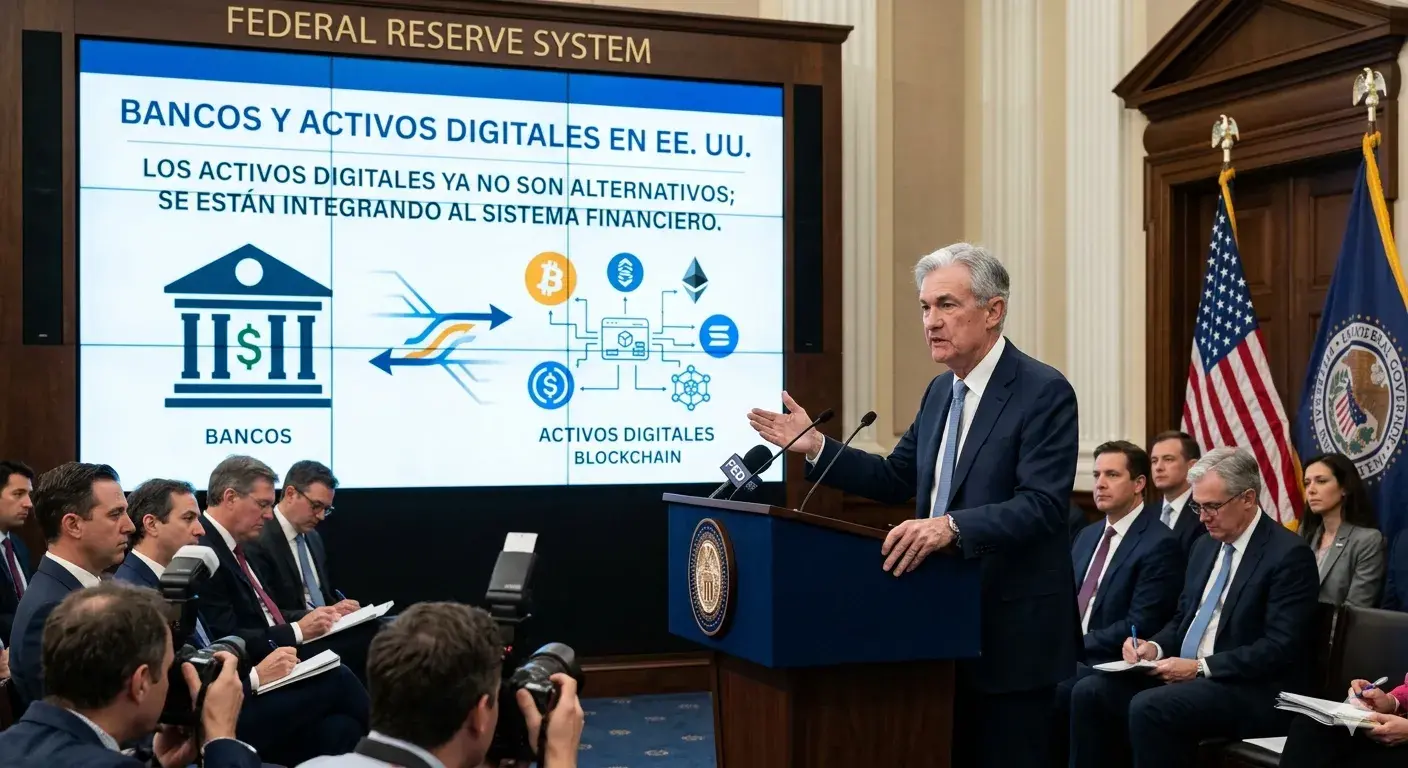
In a movement that marks a before and after for the global finance industry, the president of the United States Federal Reserve, Jerome Powell, has issued a Blunt statement that redefines the relationship between traditional banking and the cryptocurrency ecosystem. According to Powell, commercial banks are now ‘well prepared’ to serve customers related to the world of cryptocurrencies, stressing that the Integration of digital assets In the financial system it is no longer a future possibility, but a present reality.
This statement not only validates the effort of years of technological development and regulatory compliance, but also removes the ‘alternative’ label that has chased digital assets since the creation of Bitcoin. For the most important regulator in the world, these assets have gone from peripheral experiments to intrinsic components of modern economic infrastructure.
Bitcoin
The end of ‘alternative’ assets
For more than a decade, cryptocurrencies were classified by central banks as high-risk assets and merely speculative nature. However, the narrative has changed drastically. recognition of the Integration of digital assets The Fed suggests that financial institutions have managed to implement robust enough risk management frameworks to interact with exchanges, stablecoin issuers and custody providers without compromising systemic stability.
Market maturity is reflected in the ability of banks to apply policies to Know Your Customer (KYC) and Anti-Money Laundering (AML) in on-chain transactions. This has allowed the Integration of digital assets It accelerates, allowing institutional capital to flow more freedom into the crypto sector.
 Solana Captures 97% of Tokenized Stock Transactions in Landmark Month for RWAs→
 Regulation and control: The Brazilian government orders the blockade of 27 market prediction platforms→
Are the banks really ready?
Powell’s statement comes after a period of intense audit and regulatory pressure in the US banking sector. After the events of 2023, where several banks linked to the crypto sector faced difficulties, the industry has undergone a purge and a strengthening of its liquidity reserves.

Today, the Integration of digital assets It is supported by a stronger infrastructure. Custody banks and large firms such as JPMorgan and Fidelity have shown that it is possible to coexist with cryptocurrencies under strict supervision. This preparation that Powell speaks of implies that banks not only have the necessary software, but also the personnel trained to understand the volatility and technical nature of these assets.
Editor’s Note: In our section of Institutional Market We have closely followed how Bitcoin ETFs have been the first big step for this ultimate integration.
Opinions of experts and industry analysts
The reaction of the financial community has not been long in coming. Wall Street analysts and prominent blockchain ecosystem figures see in Powell’s words an institutional ‘green light’.
Caitlin Long, CEO of Custodia Bank and expert in banking regulation, commented: ‘Powell’s recognition is fundamental. However, the Integration of digital assets It requires the Fed to stop issuing vague warnings and provide a clear path for banks to operate without fear of sudden regulatory reprisals.’
On the other hand, analysts of Goldman Sachs They have pointed out in recent reports that customer demand for cryptocurrency custody and trading services has forced banks to accelerate their digital transformation. The Integration of digital assets It is no longer a marketing option, but a competitive necessity against the new fintechs.
Michael Novogratz, CEO of Galaxy Digital, maintains that this is the ‘validation moment’ that the market expected: ‘When the man who handles the dollar printer says that digital assets are being integrated into the system, the discussion about whether Bitcoin will reach zero ends forever.’
Impact on Latin America and emerging markets
For regions like Latin America, where the adoption of cryptocurrencies is driven by the need for remittances and coverage against inflation, Integration of digital assets In US banking it has direct effects. Many local banks depend on correspondent relations with US banks; If the latter are ‘well-prepared’ for the crypto world, friction for cross-border transfers based on stablecoins could be significantly reduced.
The Integration of digital assets It will make it easier for LATAM companies to use first-rate banking infrastructure to settle international payments in real time, using Bitcoin or USDC as a bridge, with the support and supervision of the Federal Reserve.
Persistent Challenges: Security and Compliance
Despite the optimism, Powell was clear that surveillance will not decrease. The Integration of digital assets It carries cybersecurity risks that traditional banks are just beginning to manage on a large scale. The protection of private keys and the prevention of hacks are land where banking must continue to learn from native cryptocurrency companies.
In addition, interoperability between real-time gross settlement systems (like FedNow) and blockchain networks remains a technical challenge. The Integration of digital assets Complete will only be achieved when a digital dollar can move as easily as an email between a bank account and a cold wallet.
Conclusion: A new financial architecture
We are witnessing the birth of a hybrid financial system. Jerome Powell’s statements confirm that institutional resistance has been replaced by a pragmatic adaptation. The Integration of digital assets It is the engine of this new architecture where the efficiency of the blockchain is combined with the trust and support of the centuries-old institutions.
For investors and users of Cryptomedia, this message is an invitation to professionalization. Digital assets have ceased to be the ‘playground’ of tech enthusiasts to become the new value standard in the global financial system.
Do you want to be up to date with the regulatory changes that affect your portfolio? Subscribe to our newsletter in Cryptomedia and receives every morning the summary of the news that moves the institutional market.
Ethereum
Disclaimer Clause: The content of this article is informative and educational. It does not represent an investment, financial or legal council. Cryptocurrencies are volatile assets and operate in a changing regulatory environment. Before making financial decisions, do your own research and consult with a professional advisor. cryptomedia.com You are not responsible for losses arising from the use of this information.